Explore the Original Historical Photographs
Explore las fotografías históricas originales
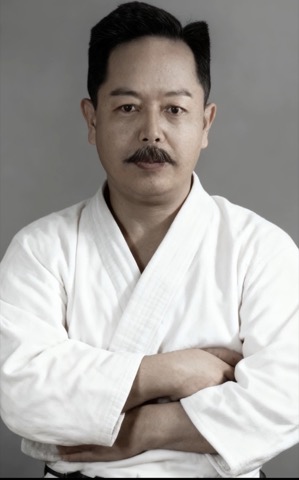
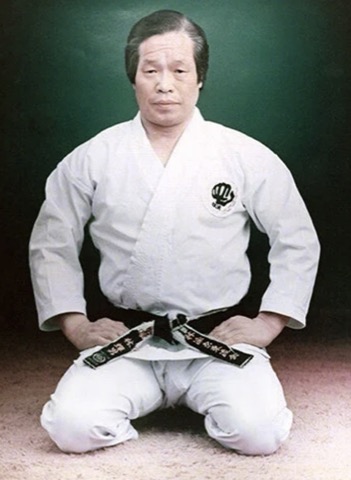
See 19 original ISKIA historical reference photographs in an interactive gallery, with enlarged viewing and source-preservation notes. Individual identities are being checked against historical evidence before attribution.
Descubra 19 fotografías históricas originales del archivo ISKIA en una galería interactiva, con ampliación y notas de conservación. Las identidades individuales se verifican antes de su atribución.
View all 19 original photographs →Ver las 19 fotografías originales →CHAPTER 01
Sōkon Matsumura 松村宗棍
The Shuri Court and the Preservation of Ti
An Okinawan court environment
Sōkon Matsumura occupies a central place in the history of Shuri-te. He is traditionally associated with service to the Ryūkyū royal court, whose officials and retainers maintained complex obligations in administration, ceremonial life and physical protection. In this setting, martial skill was connected to responsibility and status rather than to modern sporting competition. Details of Matsumura’s birth year, travels and encounters vary between later biographies and should be treated cautiously.
Technical and cultural significance
Shuri-te was not a fixed, modern style with a single standardized syllabus. It represented interacting methods transmitted among families, officials and teachers around Shuri. Matsumura is remembered as an important consolidator of this tradition. Kata such as Passai, Chintō and Gojūshiho appear in Shuri-derived lineages, but their exact routes of transmission cannot always be reconstructed from contemporary documents.
Influence on later karate
The importance of Matsumura lies in the lineages that remember his teaching and in the later Shuri-te masters who carried this knowledge forward. Ankō Itosu, whose school-teaching reforms helped reshape karate, is commonly placed within a tradition influenced by Matsumura. A historical genealogy must still distinguish direct documented lessons from relationships reported through later oral tradition.
Why he matters to ISKIA
The Shuri-te legacy is one of the two principal bodies of training that Kenwa Mabuni studied through Itosu. Matsumura therefore belongs near the beginning of the Shitō-ryū historical narrative, as an influential predecessor rather than as a directly documented teacher of the modern ISKIA organization.
Versión española ampliada en preparación. Consulte por ahora la cronología bilingüe principal.
CHAPTER 02
Kōsaku Matsumora 松茂良興作
Tomari-te and the Coastal Networks of Okinawa
The town of Tomari
Kōsaku Matsumora is remembered as a leading figure in Tomari-te, a tradition associated with the port community of Tomari. Unlike histories that imagine completely separate and unchanging Shuri, Naha and Tomari schools, the evidence points toward personal exchange, movement and gradual overlap. Tomari’s place within trading Okinawa offered opportunities for contact and for distinctive local practice.
A tradition carried through kata
Tomari-associated kata traditions, including versions of Wankan, Rōhai and Chintō, are preserved in later karate systems. It is difficult to prove that any named early master single-handedly composed a specific modern version. What matters historically is the continuity of training relationships, the survival of kata and the careful comparison of different lineages.
Place among the early masters
Okinawa’s official historical summary names Matsumora alongside Sōkon Matsumura and Kanryō Higaonna as a formative figure in the emergence of what became modern karate. He represents the importance of Tomari within the larger Okinawan martial network.
Connection to the Shitō-ryū heritage
The broad kata-preservation approach exemplified by Kenwa Mabuni drew upon diverse Okinawan sources. The Tomari heritage provides essential context for understanding why the Shitō-ryū syllabus contains kata with multiple historical associations.
Versión española ampliada en preparación. Consulte por ahora la cronología bilingüe principal.
CHAPTER 03
Gichin Funakoshi 船越義珍
From Okinawa to the Universities of Japan
Formation in Okinawa
Gichin Funakoshi grew up within the Okinawan karate environment and studied under Ankō Asato and Ankō Itosu. His later writings emphasized restraint, character and the disciplined study of technique. This ethical framework became central to his presentation of Karate-dō as an educational path, although he did not originate the Okinawan traditions he inherited.
The 1922 Tokyo demonstration
In 1922 Funakoshi presented Okinawan karate at a major exhibition in Tokyo, an event identified in official Okinawan historical accounts as a turning point for its spread on the Japanese mainland. He remained in Japan and taught students in educational and university settings, helping create a stable community of practice outside Okinawa.
Teaching a modern public
The transition from small groups of personally selected students to university clubs and organized dōjōs changed the scale of instruction. Kata naming, training conventions, uniforms, grades and organizational identities developed in new ways. The style later known as Shōtōkan developed through Funakoshi and his students; it was one important branch of a wider movement, not the origin of karate itself.
A parallel line to Mabuni
Funakoshi and Mabuni were both connected to Itosu, but their organizations followed different courses. Including Funakoshi in the ISKIA history demonstrates the wider cultural transformation that made the teaching of Shitō-ryū possible in Osaka and beyond, without inaccurately placing Funakoshi as a direct ancestor of Inoue-ha.
Versión española ampliada en preparación. Consulte por ahora la cronología bilingüe principal.
CHAPTER 04
Chōjun Miyagi 宮城長順
Naha-te, the Bubishi and Gōjū-ryū
The training heritage of Naha
Chōjun Miyagi studied under Kanryō Higaonna and became a central figure in the development of Naha-te. He is remembered for a demanding integration of conditioning, kata, breathing and close-range principles. Stories about exact individual techniques and Chinese origins differ among oral histories, so the most reliable narrative is one of technical inheritance and subsequent systematic teaching.
Naming Gōjū-ryū
The Okinawa Karate Information Center connects the adoption of the Gōjū-ryū name to an incident following a 1930 demonstration in Tokyo by Miyagi’s student Jin’an Shinzato. The name draws on the hard-and-soft principle found in the Bubishi tradition. The juxtaposition of hard and soft is a training principle, not a simple division between strength and relaxation.
Lasting technical contribution
Miyagi’s work helped transmit Naha-based kata such as Sanchin and Tenshō into a modern teaching system. Different histories attribute individual training innovations differently, but his influence on the identity and international spread of Gōjū-ryū is substantial.
Relation to Shitō-ryū
Miyagi and Mabuni were part of an interconnected Okinawan generation. Mabuni’s study of Higaonna makes their technical traditions historically related, yet Gōjū-ryū and Shitō-ryū must remain distinct organizations and lines of practice.
Versión española ampliada en preparación. Consulte por ahora la cronología bilingüe principal.
CHAPTER 05
Chōki Motobu 本部朝基
Combat, Experiment and the Debate over Application
An unusual voice in early modern karate
Chōki Motobu became known for his practical fighting experience and his emphasis on the combative application of karate. He developed a strong association with Naihanchi and methods for close-range engagement. Accounts of his challenges and fights can be embellished in retelling, but his reputation for testing technique contributed to public debate about the purpose of training.
Technique as a living method
Motobu’s importance lies partly in his refusal to reduce karate to outward appearance. His teaching placed attention on timing, distance, natural response and what movements could accomplish in actual encounters. This focus presents a useful counterpoint to the school and university movement that was unfolding at the same time.
Place in the larger history
Although Motobu does not form a simple direct teacher-to-student chain leading to ISKIA, he was one of the Okinawan masters whose work shaped twentieth-century discussion about kata and kumite. A responsible history recognizes such parallel influences without claiming nonexistent lineal succession.
Versión española ampliada en preparación. Consulte por ahora la cronología bilingüe principal.
CHAPTER 06
Chōshin Chibana 知花朝信
From Itosu’s Teaching to Shōrin-ryū
A student of Itosu
Chōshin Chibana studied with Ankō Itosu and became a major figure in preserving Shuri-te traditions after Itosu’s death. The Okinawa Karate Information Center records that he opened a dōjō in Shuri Torihori in 1919 and adopted the designation Shōrin-ryū in 1933.
The problem of preservation
When martial instruction expands beyond a teacher’s immediate circle, questions of terminology, kata sequence and organizational recognition arise. Chibana represents one answer: preserving and naming a distinct Shuri-derived line while adapting to the social conditions of modern Okinawa.
Why his line belongs in the history
Chibana was not a founder of Shitō-ryū, yet his work helps students see that Itosu’s teachings led to several significant branches. The story of karate is best explained as a network with shared predecessors and distinct inheritances, not a pyramid in which only one style possesses the past.
Versión española ampliada en preparación. Consulte por ahora la cronología bilingüe principal.
CHAPTER 07
Kanbun Uechi 上地完文
Fujian Training and the Uechi-ryū Tradition
A different route of transmission
Kanbun Uechi represents a distinct historical channel between Okinawa and China. Okinawan historical authorities describe his study of Southern Chinese boxing in Fuzhou before his return to Japan, where he taught the art subsequently known as Uechi-ryū. Reported details of training durations and individual Chinese teachers depend on organization-specific sources.
Kata and body conditioning
The Uechi tradition is known for Sanchin-based practice, body conditioning and characteristic open-hand methods. Its history is significant because it shows that Okinawan karate was not formed by only the Shuri and Naha streams associated with Mabuni.
Historical context for ISKIA
Uechi belongs within a comprehensive karate history as a parallel lineage. He should not be presented as a direct teacher of Mabuni, Hayashi or Inoue unless particular evidence is supplied.
Versión española ampliada en preparación. Consulte por ahora la cronología bilingüe principal.
CHAPTER 08
Kenwa Mabuni 摩文仁賢和
The Preservation of Kata and the Birth of Shitō-ryū
Training under Itosu and Higaonna
Born in 1889 in Shuri, Kenwa Mabuni became one of the major figures who carried Okinawan karate into mainland Japan. The official Itosu-ryū organizational chronology records that he began studying with Ankō Itosu in 1902, then trained with Kanryō Higaonna beginning in 1908. This double inheritance became fundamental to his technical work.
Research beyond one school
Mabuni’s interest went beyond the repertoire of his two best-known teachers. His historical role is best understood as a conservator and investigator of kata, applications and Okinawan martial traditions. Training across lines was possible because Okinawan teachers and students maintained human relationships that were not fully described by the later division into modern style names.
Building a tradition in Osaka
The Itosu-ryū chronology records Mabuni’s move to Osaka in 1929 and the founding of the Yōshūkan dōjō in 1934. It places the formal establishment of Shitō-ryū in 1939. These dates help explain the shift from Okinawan personal teaching to a named, organized style on the mainland.
The name and legacy of Shitō-ryū
The first character of Itosu’s name (糸) may be read as Shi and the first character of Higaonna’s name (東) as Tō in the style’s name, honoring both major teachers. What he transmitted was not merely a large catalog of kata, but a model of technical comparison, preservation and informed study. That ethos is central to the history that eventually reaches Hayashi, Inoue and ISKIA.
Versión española ampliada en preparación. Consulte por ahora la cronología bilingüe principal.
Transmission from Mabuni to ISKIA
Transmisión de Mabuni a ISKIA
A documented, bilingual study of Mabuni, Kōsei Kuniba, Teruo Hayashi, Yoshimi Inoue and Kyoshi Julio Martínez, carefully distinguishing affiliated schools and documented teacher relationships.
Estudio bilingüe de Mabuni, Kōsei Kuniba, Teruo Hayashi, Yoshimi Inoue y Kyoshi Julio Martínez, distinguiendo las organizaciones y las relaciones comprobadas de enseñanza.
Read transmission chapter / Leer capítulo →